
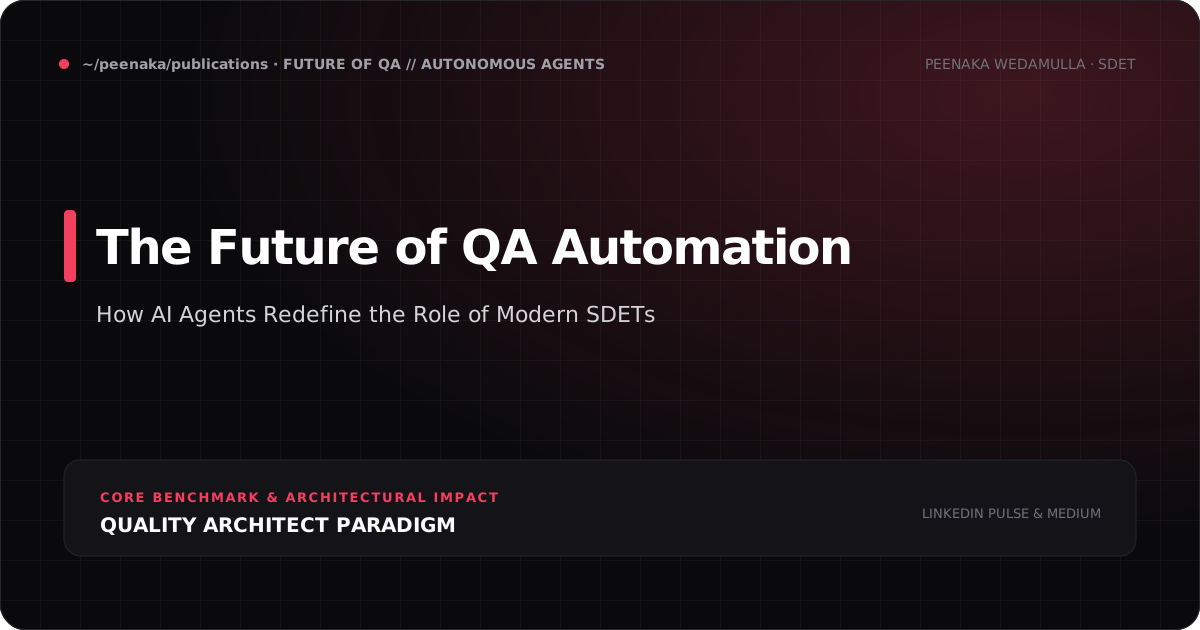
The Future of QA Automation: How AI is Redefining the Role of Testers
How autonomous testing agents, self-healing test locators, and automated synthetic data pipelines are shifting the QA engineer from reactive test writer to proactive Quality Architect.
- Future of QA
- Autonomous Testing
- Self-Healing Locators
- SDET Evolution
- AI Shift-Left
Syndicated Reading Channels
Read, share, and discuss this article on LinkedIn Pulse or Medium
The Next Evolution of the SDET
For over a decade, the primary metric of a test automation engineer was script coverage: How many Selenium, Cypress, or Playwright tests did you write? How fast does the regression suite finish?
That era is reaching its twilight. With generative AI, autonomous testing agents, and computer vision models capable of analyzing UI state in real-time, the mechanics of authoring repetitive test scripts are becoming commoditized.
Does this mean the death of QA? Far from it. It marks the transition of the QA engineer from a reactive test script writer to a strategic Quality Architect.
What Changes in the AI-Augmented QA Stack?
-
Self-Healing Test Suites: Traditional tests break when a CSS class or DOM hierarchy shifts. AI-augmented runners examine accessibility trees, semantic intent, and visual anchors to resolve targets dynamically, cutting maintenance overhead by up to 80%.
-
Autonomous Exploratory Agents: Instead of scripting every user path, agents interact with applications like curious, adversarial end-users: uncovering broken checkout flows, unhandled exception toasts, and rendering bugs across responsive breakpoints without pre-scripted steps.
-
Intelligent Synthetic Data Generation: Generating compliant, realistic test datasets that simulate real-world production distributions without violating GDPR, HIPAA, or PCI regulations.
// The Modern SDET Workflow: Orchestrating Autonomous Test Agents
import { QualityAgent } from '@internal/qa-orchestrator';

export async function runAutonomousReleaseAudit() {
  const agent = new QualityAgent({
    targetEnvironment: process.env.STAGING_URL!,
    persona: 'ADVERSARIAL_FINTECH_USER',
    budgetTokens: 50000,
  });

  // Agent explores, probes edge cases, verifies idempotency, and logs telemetry
  const auditReport = await agent.auditApplicationFlows([
    '/checkout',
    '/settings/security',
    '/cards/virtual',
  ]);

  console.log(`Audit complete: ${auditReport.defectsFound} edge bugs identified.`);
}
The 3 Core Skills Modern SDETs Must Master
- System & Security Architecture: Understanding distributed transaction flows, Kafka event buses, and zero-trust IAM to design high-leverage test strategies.
- AI & Prompt Orchestration: Knowing how to integrate LLM evaluation harnesses, validate AI output non-determinism, and prevent hallucinations in production code.
- Continuous Reliability & Observability: Moving beyond test passes to real-time production telemetry: OpenTelemetry tracing, synthetic monitoring, and progressive canary verification.
The future belongs to engineers who build quality into the software architecture from day zero.
Peenaka Wedamulla
SDET / QA EngineerQA Automation Engineer specializing in scalable test automation across web, mobile, and API platforms in FinTech. Focused on building quality from the start rather than testing it at the end.
Discussion & Feedback
Have thoughts on this test strategy? Share your experience or questions below.
Top Discussion Insights (0 comments)
JSON PersistedNo comments yet. Be the first to start the discussion below!
Add to the Discussion
Your perspective will be verified and published to the live community discussion.